
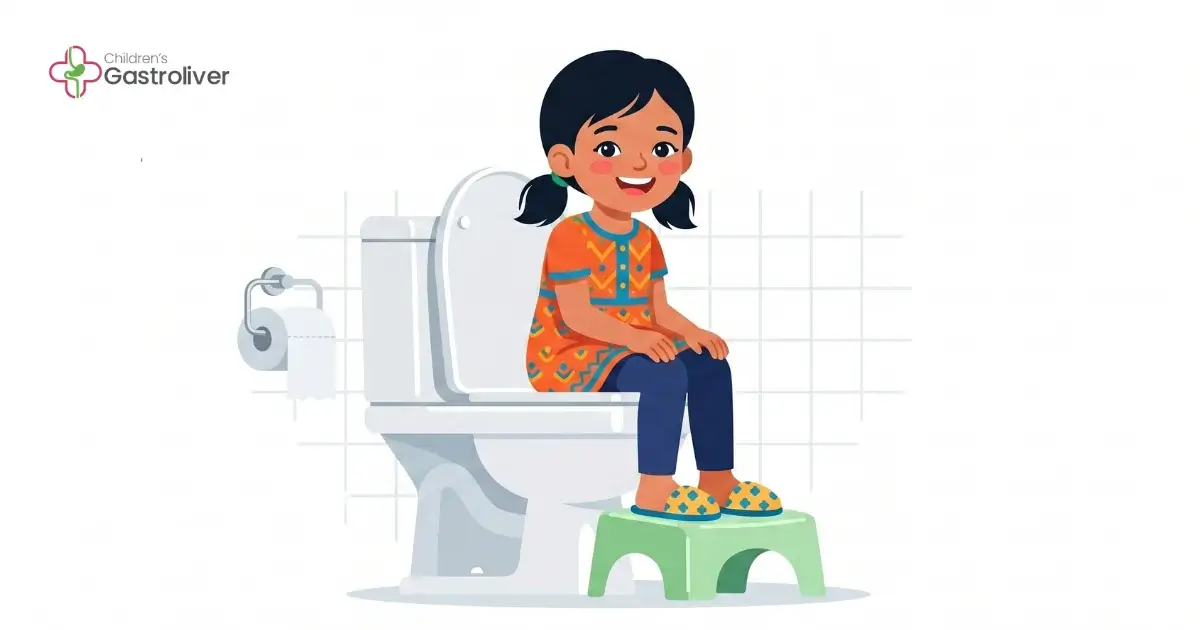
Direct answer: Yes, sitting position genuinely affects whether a child can pass stool comfortably. The evidence-backed posture — used in NASPGHAN/ESPGHAN pediatric guidelines and taught by NHS UK's ERIC (the Children's Bowel & Bladder Charity) — is: feet flat on a footstool (not dangling), knees raised above hip level, back straight but leaning slightly forward, sitting relaxed for 5–10 minutes about 15–30 minutes after a meal. Getting this posture right is a free, immediate change that works alongside diet and, when needed, medication — not instead of them.
A companion to our fruits article — a different piece of the puzzle
We've already written about high-fiber local fruits that help keep stool soft (see our earlier post on indigenous fruits for constipation relief). Diet is one part of managing childhood constipation. This article covers a different, often-overlooked part: what happens in the few minutes your child actually sits on the toilet, and why posture and timing change whether that sitting works.
Why posture actually changes the outcome (the "traffic jam" explanation)
Here's how it's supposed to work: food is digested into a soft, liquid mixture. As it passes through the large intestine, water is absorbed and it firms up into a soft, smooth, sausage-shaped stool. When stool reaches the rectum, the muscle there stretches and sends a signal to the brain that it's time to go.
Constipation happens when a child, often out of fear of pain, holds that stool in or ignores the signal. The body keeps absorbing water from the waiting stool, making it harder and larger — and it gets stuck, like a traffic jam inside the bowel.
Posture matters because of simple mechanics: when the knees are raised above the hips, the angle of the rectum straightens out, making it genuinely easier to pass stool with less strain. When feet dangle without support, the body can't relax the right muscles, and a child ends up straining against, rather than with, their own anatomy.
The correct sitting position
- Use a footstool: If your child's feet don't reach the floor when sitting on the toilet, a small stool or step is not optional — it's part of the treatment. Feet should rest flat on the stool.
- Knees above hip level: The footstool should be tall enough that your child's knees sit higher than their hips, not just so their feet touch something.
- Lean slightly forward: Encourage a straight back with a gentle forward lean, rather than sitting bolt upright or slumped back.
- Relaxed, unhurried: Don't rush your child. A tense, hurried few minutes on the toilet works against the goal.
The correct timing
Sit your child on the toilet for 5–10 minutes, about 15–30 minutes after a main meal — breakfast is especially effective. This isn't arbitrary: eating triggers a reflex (the gastrocolic reflex) that naturally increases movement in the colon, so trying right after a meal works with your child's body rather than against it. NASPGHAN/ESPGHAN pediatric guidelines specifically recommend this post-meal toilet-sitting routine as part of standard treatment for childhood constipation.
A simple technique that helps: blowing bubbles
While your child sits in the correct position, have them blow bubbles (with a bubble wand) or blow up a balloon. This isn't a distraction trick — it naturally engages the abdominal muscles in a way that helps push, without your child consciously straining or bearing down incorrectly.
What incorrect posture usually looks like
- Feet dangling, not touching the floor or a stool.
- Sitting hunched forward with knees not raised, or perched without back support.
- Rushed, anxious sitting with a parent hovering and repeatedly asking "are you done?".
If any of these describe your child's current toilet routine, the footstool and timing changes above are worth trying for at least a few weeks alongside any diet or medication plan your doctor has recommended.
Frequently Asked Questions
Does sitting posture alone cure constipation?
No — posture is one part of a full plan that usually also includes adequate fiber and water intake, and sometimes a doctor-recommended laxative. But it's a free, same-day change that makes every other part of treatment work better.
How do I know if the footstool is the right height?
Your child's knees should be visibly higher than their hips when sitting, with their feet flat on the stool, not just barely touching it.
Why after meals specifically?
Eating triggers a natural reflex that increases colon activity, making that window the most effective time to try, rather than a random point in the day.
My child is scared of the toilet and holds stool in — does posture help with that?
Correct, relaxed posture combined with an unhurried, pressure-free routine can reduce the anxiety that leads to stool-holding, but a child who is actively withholding stool due to fear or pain should also be evaluated by a doctor.
Is this different from what causes constipation in the first place?
Yes — most childhood constipation isn't caused by a serious underlying disease (it's "functional," meaning there's no structural problem). Posture and timing address how effectively your child can pass the stool they already have, alongside diet, which affects how soft that stool is to begin with.
A note from Dr. Rafia Rashid
Dr. Rafia Rashid is a pediatrician and pediatric gastroenterologist (FCPS, Pediatrics; FCPS, Pediatric Gastroenterology & Nutrition) with over 18 years of experience, and Assistant Professor at Bangladesh Shishu Hospital & Institute. She shares a step-by-step toileting posture guide — footstool height, timing, and the bubble-blowing technique — with every family she treats for constipation, alongside a diet and water tracker.